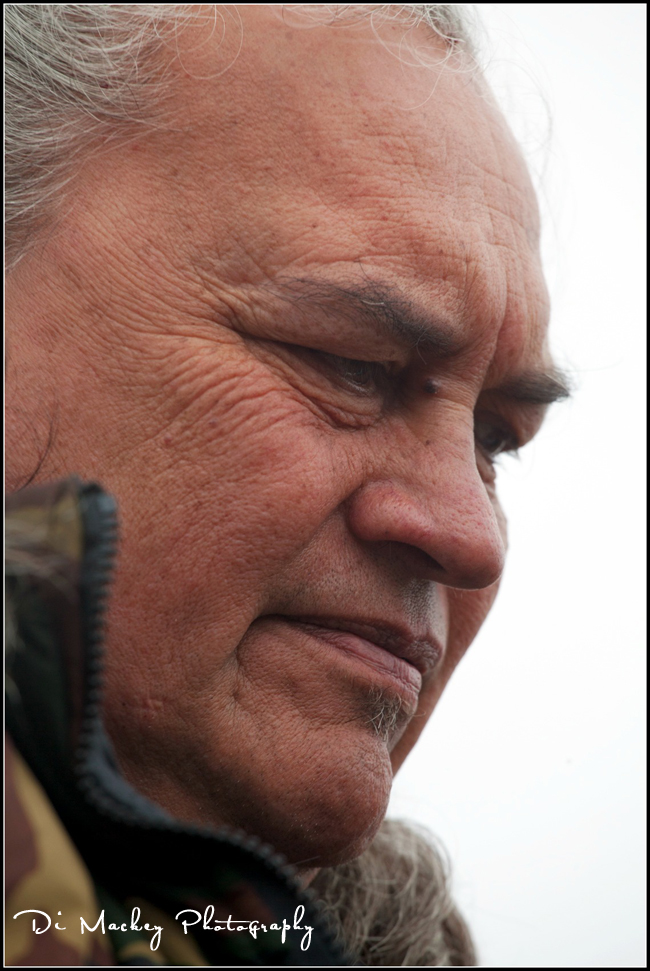
Lenn

I met Lenn at the Peace Village, out on Flanders Fields, yesterday and asked if I might document the story of a New Zealand Hangi.

He said yes.

And what I didn't know was that it's as much about cooking the food as it is about the people involved ... and those drawn in when it comes time to share the food.

In the end I felt extraordinarily fortunate to be there for those hours and I felt my little Kiwi soul fill up and overflow with joy.

It was extraordinary.

Thank you, Lenn, for putting up with my camera and I.

The Hangi Blokes, Flanders Fields

I captured these kiwi blokes taking a well-earned break after finishing up work on the Hangi.

You really couldn't wish to meet nicer, harder-working, big-hearted, highly-amusing Kiwi blokes than these guys.  They simply impressed me ... and made me laugh more than once.

The Tino Rangatiratanga Flag

It’s been over 20 years since the birth of the Tino Rangatiratanga flag with Rangitaane Marsden citing its launch date as the 6th of February 1990.  Now it has been adopted by many and flies in places of significance across the nation.

Rangitaane Marsden says “the flag in a sense reflects the creation story but if you take it to another level black reflects the potential, red reflects the realities and white reflects the wisdom and illumination that come with a persons own individual being”.

Source: Māori News, the Origins of the Māori Flag.

I spent most of yesterday outside in a field near the Peace Village, photographically documenting a Hangi.

The image below was taken while they were still heating up to tiles used in the hangi pit.  It was a stunning fire ... one that burned so hard and so long.  I was fascinated.

Thank you, so much, to Lenn Krosschell and those helping him for allowing me to hang round and take photographs.

And there in the background, the Tino Rangatiratanga Flag blowing strong in that Flanders Fields breeze.


Ngāti Rānana, on Flanders Fields, Belgium


Ngāti Rānana London Māori Club aims to provide New Zealanders residing in the United Kingdom and others interested in Māori culture an environment to teach, learn and participate in Māori culture.

The three guiding principles of Ngāti Rānana are whanaungatanga (togetherness), manaakitanga (looking after one another/hospitality) and kōtahitanga (unity).

Source: the Ngāti Rānana website.

These guys were in Mesen/Messines this weekend and they touched the hearts of everyone who saw them perform.


Ralph Hotere, New Zealand Artist

He was very gentle but held strong views and was extremely inquisitive and interested in many things.

Jeanne Macaskill, artist, describing Ralph Hotere

I think, sometimes, we can grow lacking appropriate role models.  We assume we fit the world wrong and that we carry the burden to change.  But it's untrue.  I think it is more that the institutions that define and model 'correct' behaviour often have it all wrong.

Rather than exploring the full range of what it is to be human, we are shaped so as to fit the structure already in place.

I wish someone had told that it was possible to be gentle and hold strong views.  That one didn't cancel out all possibility of the other.  Strong views do not a monster make. 

The word most used in describing Ralph is the word generous.  That is how friends and colleagues remembered him and yet, he was a man of strong political views ... a man who believed 'art and politics are not separate things, because life does not allow them to be.'

He was described as a warrior artist.  His greatest works embraced great causes.  He used elegance, power, and beauty.  He was a builder of bridges between people.  These are just a handful of the things I've read about Ralph Hotere.

Source: Mirata Mita's documentary series at the end of this post

New Zealand poet Cilla McQueen, one of Hotere's 3 wives wrote 3 beautiful fragments on the Listener magazine's memorial page to Ralph after his death in 2013.  She wrote of time spent in Avignon as a family, 'We knew these were precious days, of dappled sunlight, warm earth, lavender, grapes, melons, rosé wine. I wrote because a camera was not enough.'

He was a talented artist, a stunningly generous man who gave away more then half of his art - gifts to friends, a silent man who believed that 'there are very few things I can say about my work that are better than saying nothing', a man who understood 'precious days' ... a man I don't want to forget because he shows that it's okay to be everything, to own that character that makes us so uniquely ourselves.